
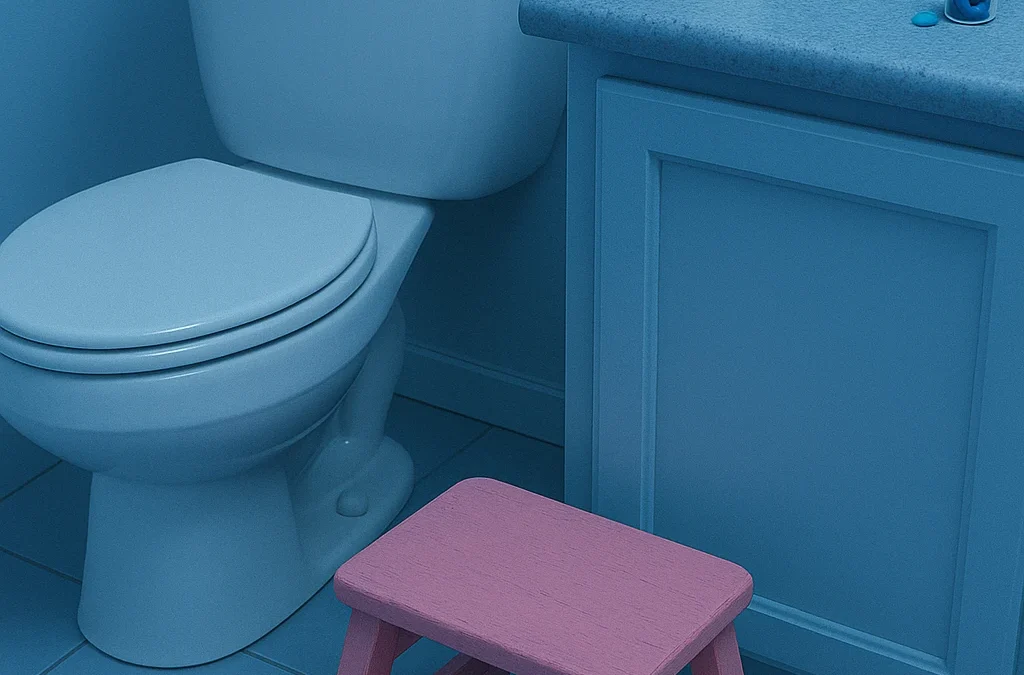
Disclosure: I have no financial incentive for recommending the Squatty Potty or other toilet stool. This information is strictly based on my professional opinion.
If you’ve ever seen a Squatty Potty or similar toilet stool and wondered, “Does that thing really work?”, you’re not alone. It might look a little funny, but the concept behind it is surprisingly scientific, and it’s all about posture.
When we use a traditional toilet, our hips and knees sit at roughly a 90-degree angle. In this position, a band of muscle called the puborectalis, which loops around the rectum and connects to the pelvic floor, stays slightly tensed. This creates a natural “kink” in the rectum that helps us stay continent between bathroom visits. While this is great for holding things in, it’s not the ideal position for letting things out.
By raising your feet on a small stool, your knees move closer to your chest, changing that angle from 90 degrees to around 100-110 degrees. This gentle shift helps the puborectalis muscle relax and straightens the rectum, allowing for a smoother, easier passage of stool. Think of it like aligning the plumbing before turning on the water; the flow just works better when everything is lined up.
This simple posture change can make a noticeable difference. Research has shown that using a toilet stool can lead to faster, more complete bowel movements, less straining, and a greater sense of relief afterward (Rahgoshay, 2025; Sebo, 2022). Many people who use a stool describe feeling “lighter” or more comfortable after using the bathroom, and some even find it helps reduce symptoms of constipation and bloating.
The benefits go beyond comfort. Regular straining can put pressure on the pelvic floor, which over time may contribute to hemorrhoids, rectal prolapse, or other pelvic issues. By supporting a more natural squatting position, a toilet stool helps the body eliminate waste more efficiently and with less effort. This simple adjustment can be especially helpful for anyone with chronic constipation, hemorrhoids, or pelvic floor dysfunction, or for those who just want to make bathroom trips quicker and easier.
If you’ve ever felt frustrated by how long it takes to “go” or find yourself straining more than you’d like to admit, a toilet stool is a safe, inexpensive, and noninvasive way to help. You don’t need to overhaul your bathroom setup; just place a sturdy stool under your feet, lean forward slightly, and breathe. It may feel different at first, but after a few days, most people can’t imagine going back to a standard sitting position.
While no device can replace the importance of fiber, hydration, and regular movement, using a toilet stool is one of the simplest and most effective changes you can make to support healthy digestion. Sometimes, the path to better gut health doesn’t start in the kitchen, it starts with how you sit in the bathroom.
References
Rahgoshay, N., Rahdar, M., Nikoo, L., & Daneshmandi, H. (2025). Sitting vs. squatting: A scoping review of toilet postures and associated health outcomes. BMC Public Health, 25, 2192. https://doi.org/10.1186/s12889-025-23379-8
Sebo, P., Quinio, C., Viry, M., Haller, D. M., & Maisonneuve, H. (2022). Perceived effectiveness and overall satisfaction of using a toilet stool to prevent or treat constipation: An analysis of online comments. Journal of the American Board of Family Medicine, 35(4), 836–839.https://doi.org/10.3122/jabfm.2022.04.210474